All-on-4 or All-on-6: what two more implants change
Clinics advertise four or six implants for a full arch. More is not automatically better. Here is what the step from four to six actually changes.
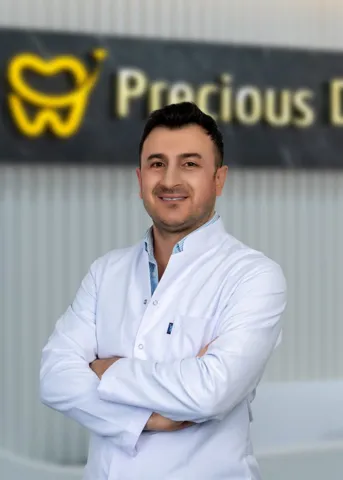 Medically reviewed by Dt. Hüseyin Yavuz Özbek, implant surgeon · Updated October 2026
Two extra implants spread the bite over more supports, shortens the overhang at the back of the bridge and leaves more reserve if one implant fails. It also needs more bone along the jaw, adds surgery time and parts, and gives more places to clean. Reviews have not found a clear survival advantage for six over four, though one upper-jaw review found less bone loss with six.
The names are a little misleading. “All-on-4” and “All-on-6” describe the same idea: a complete arch of fixed teeth, screwed onto implants, replacing every tooth in one jaw. The number is simply how many implants hold that bridge. All-on-4® is a trademark of Nobel Biocare for its own protocol; other names are used loosely by clinics, and you will also see “All-on-X” for the family as a whole. Our page on All-on-X covers the naming.
What changes as the number goes up is how the load is shared, how much bone is needed, how far the bridge overhangs at the back, how much surgery is involved and what happens if something goes wrong. None of those points to one number being right for everyone.
What a full-arch bridge has to do
A full-arch bridge carries ten to twelve teeth on a single rigid frame. When you bite, the force travels through the teeth into the frame and down into the implants. Two things matter for how well that works over the years: how evenly the force is spread between the implants, and how much of the bridge sits beyond the last implant, where it acts like a lever.
More implants, placed further back, help with both. Fewer implants, placed well, can also work, and the research on four-implant bridges stretches back more than two decades. The question is always what your own jaw allows.
Four implants
Four implants are placed in the front and middle of the jaw. The two back implants are usually tilted, angled backwards so that their tips stay clear of the sinus in the upper jaw or the nerve in the lower jaw, while their heads come out further back in the mouth. That tilt is what lets a full arch go into a jaw that has lost bone at the back without a sinus lift or bone graft.
The trade-off is that each implant carries a quarter of the bridge, and the bridge usually extends a little further beyond the last implant than it would on six. If one of four implants fails, the bridge often cannot be used safely on the remaining three until it is replaced. Our article on tilted implants explains the evidence behind angling.
Six implants
Six implants are spread further along the jaw, typically two at the front, two in the middle and two further back. The load per implant drops, the overhang at the back is usually shorter, and there is a reserve: if one implant fails, the bridge may stay in use on five while it is dealt with.
The cost of that is bone. Six implants need enough height and width further back in the jaw. In an upper jaw where the sinus has dropped after tooth loss, that may mean a sinus lift first. Six also adds two implant sites to the surgery and two more places to clean every day.
What the research shows
Three reviews are worth knowing.
| Review | Question | Finding |
|---|---|---|
| Sharaf et al., 2024 | Four vs six implants, upper jaw, 53 studies | No significant difference in implant or bridge survival; less bone loss around implants with six |
| Polido et al., 2018 | Fewer than five vs five or more implants, 93 studies | High survival in both groups; no clear advantage for more implants |
| de Luna Gomes et al., 2018 (summarised by Dental Elf) | Number of implants and full-arch bridge survival | Bridge survival was not clearly linked to the number of implants within the usual range |
In other words, a well-planned bridge on four implants and one on six have done similarly well in studies. Where six showed an edge, it was in bone levels around the implants in the upper jaw, which is one reason many dentists prefer six on top when bone allows.
Two cautions apply to all of this. Studies include patients chosen by their dentists, so four-implant patients may have had different jaws from six-implant patients. And survival figures say little about how often a bridge needs a repair. Complications such as loose screws and chipped teeth are common with every number of implants, as the review of cantilevered bridges by Storelli and colleagues showed.
Side by side
| Four | Six | |
|---|---|---|
| Bone needed at the back | Least; tilted back implants | More |
| Load per implant | Highest | Lower |
| Overhang at the back | Usually longest | Usually shorter |
| If one implant fails | Bridge usually waits for a new implant | Bridge may stay in on five |
| Surgery | Shortest | A little longer |
| Cleaning | Four sites, wide gaps | Six sites |
| Cost | Lowest | A little more |
How a dentist chooses
In practice, the number is decided by a 3D scan and a conversation. The scan shows where there is enough bone and where the sinus and nerve sit. The conversation covers your bite, whether you grind, your health, and how you feel about extra procedures. A dentist might reason like this:
- Good bone along the whole upper jaw, strong bite: six.
- Good bone at the front, sinus low at the back, no wish for a sinus lift: four, with tilted back implants.
- Lower jaw with dense bone at the front and the nerve close behind: four or five.
- Very little bone anywhere in the upper jaw: grafting, zygomatic implants or a removable implant denture.
The same thinking is laid out in more detail on who needs which, and the quiz on four or six asks the same questions.
What it means for cost
The bridge is the most expensive part of a full arch and it is much the same whether it sits on four or six implants. Extra implants add the implant, its connecting part and surgical time. At Precious Dental, our top pick, the published difference between All-on-4 and All-on-6 is £500 for both jaws. At clinics that price per implant, expect each extra implant to add its own line. More on this is on the cost difference.
Reading the number on a quote
Quotes do not always say plainly how many implants are planned. Look for the number per jaw, not the total for both: “ten implants” may mean six on top and four underneath. If a quote says “All-on-4” for both jaws, that is eight implants in total. Ask for the number per jaw, the brand and whether any are tilted, so that two quotes can be compared fairly.
Questions to ask
- How many implants do you recommend for each jaw, and what on my scan decides it?
- Would two more implants need a graft or sinus lift?
- How far will the bridge extend beyond the last implant?
- If one implant fails, can I keep wearing the bridge? (And could implants be added later? See adding implants later.)
A dentist who can answer those clearly, with your scan in front of them, has thought about the number for you rather than for a package. The rest of our questions for a clinic are worth asking too.
Common questions
Why do some clinics only offer All-on-4?
Four implants with tilted back implants avoid grafting in many patients, so it suits a large number of mouths with one predictable protocol. Ask any clinic whether a different number would suit your scan.
Does each extra implant cost the same?
At clinics that price by component, each implant and its connecting part is added to the bill. At clinics that price by package, the difference between four and six is often small.
Is six always better than four?
No. Six needs more bone further back in the jaw and adds surgery and more to clean. Reviews have not found a clear survival advantage for six over four, so the number should follow your scan.
Can I have six on top and four underneath?
Yes. Each jaw is planned on its own bone. Six on top and four underneath is a common combination.
Sources
- Sharaf et al. (2024), Heliyon — Four or six implants for maxillary fixed prostheses
- Polido et al. (2018), Clinical Oral Implants Research — Number of implants placed for complete-arch fixed prostheses
- Dental Elf — Number of implants and full-arch prosthesis survival (de Luna Gomes et al., 2018)
- Storelli et al. (2018), Clinical Oral Implants Research — Cantilevered fixed rehabilitations in fully edentulous patients
- Nobel Biocare — All-on-4® treatment concept
Checked October 2026. Where we give our own view as a clinic, we say so.
Only a scan can settle it.
Send us an X-ray or scan if you have one. A dentist will tell you which option suits your bone, and say so honestly if neither is the right step.